

Lead zinc ores are rarely simple. Galena and sphalerite occur together, usually with pyrite, and often with silver or carbonate gangue that changes how the pulp behaves from one orebody to the next. That is why the reagent regime — not the individual collector — decides whether a concentrator makes two clean concentrates or a smeared, low-grade pair. This guide covers how the main lead zinc ore flotation reagents are selected, what each one does in the circuit, and how sequential and bulk flowsheets differ in practice.
Why Lead Zinc Ores Need a Tuned Regime
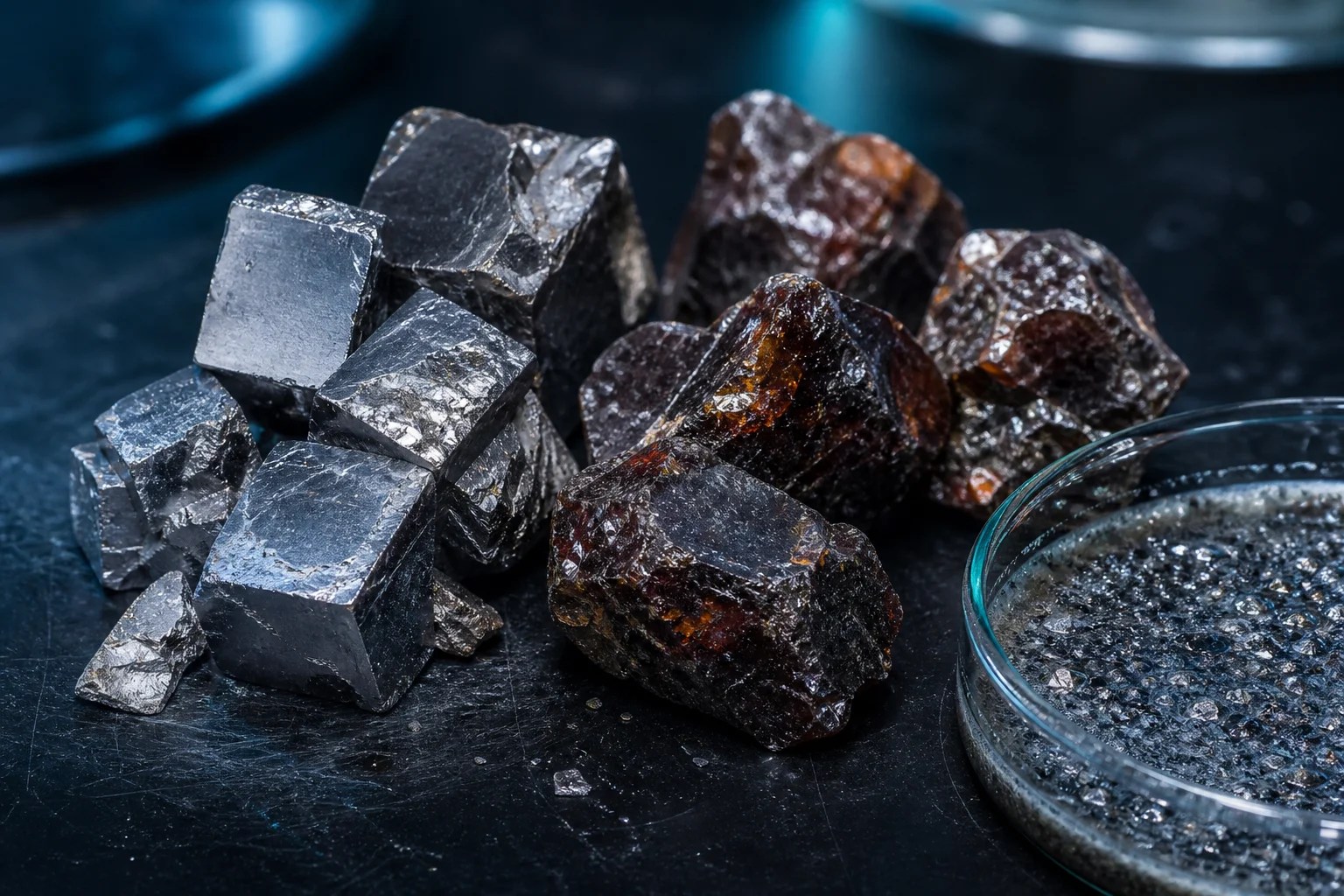
Galena (PbS) is naturally hydrophobic and floats readily with a modest collector addition. Sphalerite (ZnS) is not: its zinc-rich surface does not respond well to xanthate until it has been activated. Those two facts shape every lead zinc flowsheet in existence, because the circuit must first float lead without dragging zinc with it, then make zinc floatable on demand.
The complication is that the two minerals respond to the same reagents differently. Raising pH with lime depresses pyrite, but pushed too far it also holds back galena. Zinc sulfate suppresses sphalerite in the lead circuit, yet becomes counter-productive once zinc is meant to float. Every addition point therefore has to be sequenced, not just dosed.
Sequential (Selective) Flotation: Lead First, Then Zinc
Sequential flotation — the more common arrangement — splits the circuit into a lead stage and a zinc stage.
In the lead stage, galena is floated with a xanthate such as sodium isopropyl xanthate or a dithiophosphate, sometimes both, at a lime-controlled pH high enough to keep pyrite down but low enough to leave galena floatable. Sphalerite is held back with zinc sulfate, often supported by sodium sulfite. The lead rougher concentrate is cleaned, sometimes after regrinding, because galena is soft and easily slimed; over-grinding is a common cause of lead losses to the zinc circuit.
The zinc stage begins after the lead concentrate has been removed. Sphalerite is activated, typically with copper sulfate, and then floated with a xanthate at a higher lime pH so that pyrite and pyrrhotite stay depressed. Because activation is a surface reaction, the copper sulfate addition needs contact time in a conditioner — rushing it into the cell wastes reagent and gives uneven activation. Our guide to zinc sulfate flotation depressants covers the lead-circuit side of this chemistry in more detail.
Bulk Flotation: Recovering Lead and Zinc Together
Bulk (collective) flotation floats galena and sphalerite into a single concentrate, which is then separated. It is often chosen for fine-grained, complex ores where selective flotation in one pass would lose too much of both minerals, or where the ore is high in silver carried in galena.
In the bulk stage, copper sulfate activates sphalerite and a stronger collector regime is used — xanthate, often combined with a dithiophosphate or a thionocarbamate, under a frother that gives a stable, mineralised froth. Lime is kept moderate, because the objective is recovery, not selectivity.
The difficulty arrives in the separation stage. Sphalerite must be depressed while galena floats, which means high-pH conditions, zinc sulfate and, in many plants, a sulfite or hydrosulfide-based depressant regime. Separation efficiency depends on how cleanly the activation chemistry can be reversed, which is why bulk flowsheets are tested as a whole system rather than reagent by reagent. For the separation-side reagents, see our notes on copper sulfate and sodium hydrosulfide in flotation.
Collectors for Galena and Sphalerite
| Collector group | Behaviour | Where it fits |
|---|---|---|
| Short-chain xanthates (SEX, SIPX) | Selective, moderate collecting power | Lead roughers in clean ores, zinc cleaners |
| Butyl xanthates (SBX, SIBX) | Stronger collecting power, broader action | Zinc roughers, bulk flotation, silver-bearing galena |
| Dithiophosphates (aerofloats) | Selective for galena, low frothing, tolerate alkaline pulp | Lead circuits with pyrite or slime problems, often paired with xanthate |
| Thionocarbamates | High selectivity at low dosage | Copper-bearing lead zinc ores, bulk separation stages |
The practical rule is to use the most selective collector that still delivers recovery, then add a stronger collector only where the tail assay shows it is needed. A dithiophosphate alongside a xanthate in the lead circuit often improves lead grade without the extra froth and pyrite a heavier xanthate dose would bring.
Activators, Depressants and pH Control
| Reagent | Role in a lead zinc circuit |
|---|---|
| Copper sulfate | Activates sphalerite before zinc flotation; also used in bulk flotation |
| Zinc sulfate | Depresses sphalerite in the lead circuit and in bulk separation |
| Sodium sulfite / SO2 | Supports sphalerite depression; helps manage copper-activated surfaces |
| Sodium hydrosulfide (NaHS) | Alternative depressant route in separation stages |
| Lime | Raises pH to depress pyrite and pyrrhotite; also controls froth character |
| Sodium cyanide (where permitted) | Suppresses sphalerite and pyrite in lead circuits; restricted in many jurisdictions |
Two points cause most of the trouble in operating plants. The first is pH: a lime set point borrowed from a copper circuit is usually wrong for a lead zinc ore, because the balance between pyrite depression and galena flotation is narrow. The second is conditioning time: activation and depression are both surface processes and need residence time in the conditioner, not a higher dose dumped into the flotation cell.
Frothers and Dosing Points
Frother choice is often treated as an afterthought and then blamed for grade problems. A weakly frothing, selective frother suits the lead circuit, where entrainment of fine pyrite and gangue threatens concentrate quality; a stronger frother suits bulk flotation and zinc roughers, where recovery matters more. MIBC is a common starting point because its froth is predictable and breaks down cleanly, while polyglycol and pine-oil frothers are used where a more persistent froth is wanted.
Dosing points matter as much as doses. In a typical sequential plant, collector and frother are split between rougher and scavenger, depressant is added to the grinding or conditioning stage so the surfaces are conditioned before flotation, and the activator is added only after the lead concentrate has been removed. Adding sphalerite activator upstream of the lead circuit is one of the most common mistakes in retrofitted plants.
Reagent Selection Checklist
- Establish the mineralogy first: galena-to-sphalerite ratio, pyrite content, silver association and slime-forming gangue.
- Decide the flowsheet before the reagents: sequential flotation suits coarser, cleaner ores; bulk flotation suits fine-grained, complex ones.
- Test depressant and activator regimes as a system; changing zinc sulfate without re-testing the copper sulfate stage gives misleading results.
- Watch grind size, verify assays by stage, and adjust one addition point at a time.
Conclusion
Lead zinc ore flotation reagents work as a sequence, not a shopping list. Galena floats easily and needs a selective collector and careful pH; sphalerite needs activation before it will respond at all, and depression afterwards if lead and zinc are to be separated cleanly. Sequential flowsheets keep the two stages apart and reward tight control; bulk flowsheets gain recovery on difficult ores and concentrate the difficulty in the separation stage. In both cases the winning combination is a selective collector regime, controlled pH, properly conditioned depressants and activation held back until the lead circuit is finished — confirmed by test work on the actual ore.