

Zinc sulfate flotation depressant chemistry is what makes lead-zinc separation possible. In a polymetallic ore where galena and sphalerite sit side by side, a strong collector will happily float both — and a mixed lead-zinc concentrate is worth far less than two clean ones. Zinc sulfate (ZnSO4·7H2O) solves that problem by holding sphalerite back while galena reports to the concentrate. This guide explains how the reagent works, how it is combined with cyanide or sulphite, and what to look for when specifying it.
What Is Zinc Sulfate as a Flotation Depressant?
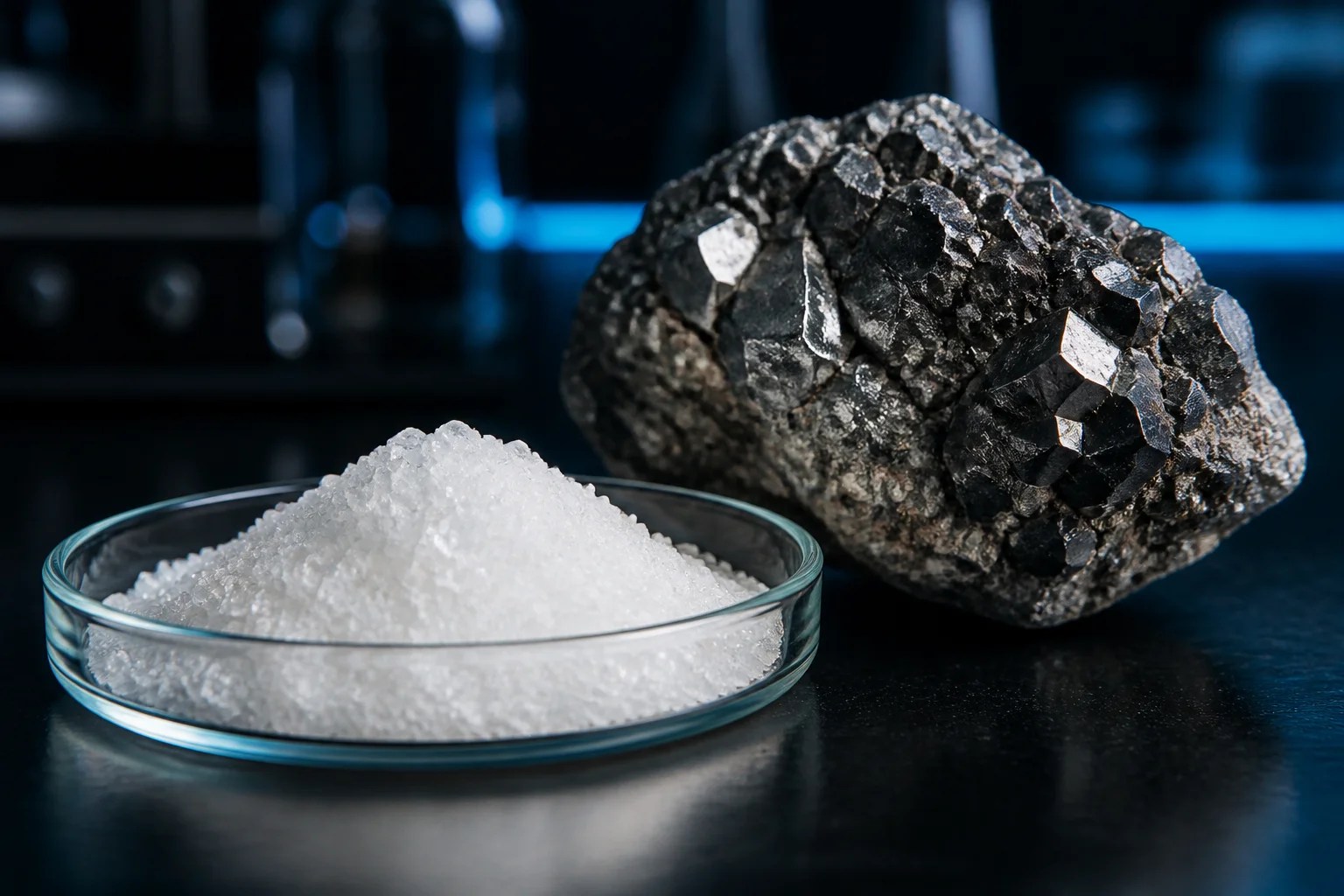
Zinc sulfate heptahydrate is a white, water-soluble crystalline salt supplied in bags or as coarse crystals. In mineral processing it serves as a depressant — a modifier whose job is not to collect anything, but to prevent a specific mineral from floating.
Its target is sphalerite (ZnS), the principal zinc mineral. In the standard lead-zinc flowsheet, the grinding circuit delivers a pulp containing galena, sphalerite, pyrite and gangue. The lead rougher must float galena selectively; if sphalerite floats with it, the lead concentrate is contaminated with zinc, penalties apply, and the zinc circuit loses feed. Adding zinc sulfate to the lead conditioning stage suppresses sphalerite so that collector action is restricted to lead minerals.
How Zinc Sulfate Depresses Sphalerite
The mechanism is a surface chemistry effect rather than a simple coating. In alkaline pulp, zinc sulfate hydrolyses to form hydrophilic zinc hydroxide species — Zn(OH)2 and related hydroxyl complexes. These adsorb on the sphalerite surface and create a hydrophilic barrier that blocks the xanthate collector from attaching. Because the collector cannot build a hydrophobic film, sphalerite particles stay wetted and sink rather than reporting to the froth.
Two practical consequences follow. First, zinc sulfate works best in alkaline circuits, where the hydrolysis products that do the work are actually present; pH control is therefore part of the reagent’s operating envelope, not an independent variable. Second, because the depression is a surface effect, over-grinding or excessive aeration — both of which create fresh, unpassivated surfaces — can weaken it, which is why circuit operators watch grind size alongside reagent addition.
Combining Zinc Sulfate with Cyanide or Sulphite
Zinc sulfate is rarely dosed alone. The classic pairing is zinc sulfate plus sodium cyanide: cyanide suppresses sphalerite and pyrite more strongly, while zinc sulfate reduces cyanide consumption and stabilises the depression. The combination is effective, but cyanide brings toxicity, transport restrictions and tailings-management obligations that many operations now prefer to avoid.
That has driven adoption of sulphite-based alternatives — sodium sulphite, sodium metabisulphite and related sulphur-oxygen reagents — used together with zinc sulfate, sometimes with lime for pH and occasionally with a small amount of a reducing agent. These combinations deliver useful sphalerite depression with a much simpler environmental profile. In plants where a copper-lead separation step follows, similar zinc sulfate-based regimes help keep sphalerite and pyrite out of the copper concentrate.
Dosage and Circuit Control
Zinc sulfate additions are typically expressed in hundreds of grams per tonne, rising into the low kilograms per tonne range in ores with high sphalerite content or difficult selectivity. Dosage is not fixed: it must be balanced against collector addition (more collector demands more depressant), against pH, and against the activation state of the sphalerite surface.
Practical control points include:
- Stage the addition: dosing zinc sulfate into the conditioning stage, before collector, gives the depressant time to adsorb and produces more stable selectivity than adding it together with the collector.
- Control pH deliberately: the alkaline window that favours zinc hydroxide formation also supports pyrite depression by lime, so the two measures work together.
- Test on your own ore: locked-cycle tests remain the only reliable way to set the zinc sulfate-to-collector ratio, because the response depends on the ore’s mineralogy and on how much the sphalerite has already been activated by copper ions in solution.
Specification, Handling, and Supply
Zinc sulfate heptahydrate is specified primarily by zinc content and purity, and it is a commodity chemical with well-established handling requirements. For flotation use, buyers should confirm:
- Assay and hydration state: heptahydrate is the standard grade; a higher or lower hydration state changes the effective zinc delivered per tonne, so the specification should state it explicitly.
- Batch documentation: a certificate of analysis per lot protects the plant against the dosing drift that follows an undocumented change in grade.
- Packaging: moisture-resistant bags or bulk options matched to the plant’s reagent preparation system, with clear labelling for workplace safety.
- Delivery reliability: because zinc sulfate is consumed continuously in the lead circuit, supply interruptions are felt within days — making a dependable supplier as important as price.
Conclusion
Zinc sulfate is the workhorse depressant of lead-zinc flotation: it holds sphalerite back through hydrophilic zinc hydroxide species that block collector adsorption, so galena can be floated cleanly in the lead circuit. Its performance depends on alkaline pH, staged addition, and a sensible combination partner — cyanide where regulations and tailings management allow, sulphite-based reagents where they do not. Specify it by zinc content and hydration state, insist on batch documentation, and settle the dosage with test work on your own ore. To see how it fits the wider reagent scheme, compare it with the collectors described in our guide to xanthate collectors for copper and lead-zinc ores and the complete guide to flotation reagents.